The Little Book of the Icelanders in the Old Days by Sigmundsdottir Alda
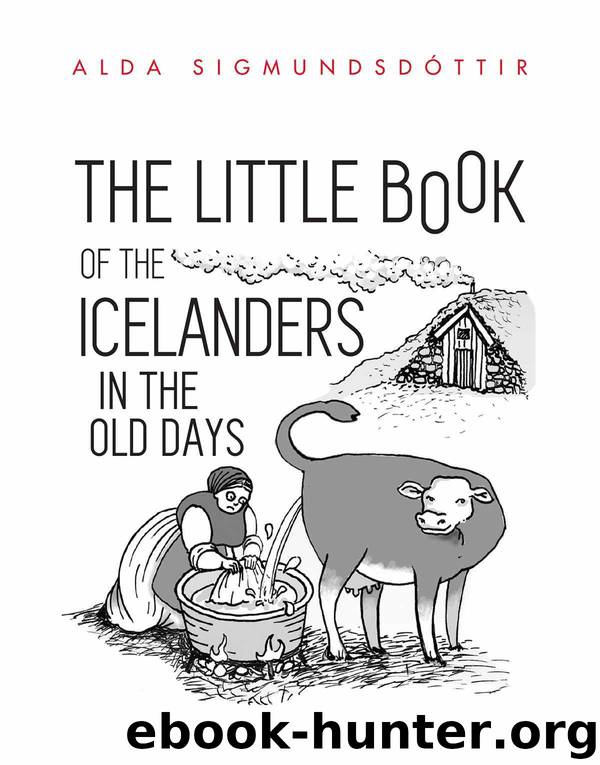
Author:Sigmundsdottir, Alda [Sigmundsdottir, Alda]
Language: eng
Format: mobi
Publisher: Enska textasmidjan
Published: 2014-06-21T16:00:00+00:00
27 Lamb in a barrel
Without question, the single most important animal in Iceland back in the day was the sheep. Without the sheep, the Icelandic people would have been extinct within a few years of settlement on their hostile, weather-beaten rock.
A wealthy man in the Iceland of old was a man who owned many sheep. Even today the Icelandic word fé means both “money” and “sheep”, and the old word for “shepherd”, féhirðir, is the word used for “treasurer” today.
It should come as no surprise, then, that lambing season was one of the most important, and delicate, times of year. Bringing those little lambs into the world and keeping them alive was a task that was not to be taken lightly.
But sometimes a lamb wouldn’t make it. When that happened, the immediate problem was how to keep the ewe milking as long as possible, since ewes’ milk was a staple of the Icelanders’ diet. If a ewe lost her lamb, another lamb had to be found as its replacement.
This usually meant taking a lamb from a ewe that had one to spare, and parading that lamb in front of the bereaved ewe to try to get her to adopt it. This didn’t always work, since it turns out that ewes are a bit particular and will not allow just any old lamb to suckle their precious teats. A strategy was required. This sometimes involved rubbing the liver of the lamb that had died on the head of the lamb that was supposed to be its replacement. If that didn’t work, the hide of the dead lamb would be sewn onto the replacement lamb, after which it would be locked inside a shed with its intended foster mother. Ideally the ewe would be duped by this crafty plan and think that the lamb with the sewn-on hide was her own little lamb come back to life.
If all else failed, and the stubborn ewe refused to adopt the lamb, the changeling would be put inside a barrel where it would commence to bleat incessantly. The ewe would be tied up next to the barrel, or confined in a small space next to it. When the lamb was finally released, the ewe would ideally break down and gather the baby to its bosom. I suppose even the hardest-hearted ewes have trouble withstanding the pitiful bleating of a lamb in a barrel ... though of course it’s possible she just wanted to stop that bloody noise.
On the other hand, if the situation was reversed - if the ewe died and the lamb lived - the first course of action was to try to get another ewe to adopt it. If that didn’t work (see above), the orphaned lamb would usually be taken in by the farm folk. Such lambs were called heimalningar, “home raised”, and tended to become the household darlings, since they invariably grew very attached to the farm people. This was especially true of the children, who were often charged with their feeding.
Download
This site does not store any files on its server. We only index and link to content provided by other sites. Please contact the content providers to delete copyright contents if any and email us, we'll remove relevant links or contents immediately.
Spell It Out by David Crystal(36240)
Underground: A Human History of the Worlds Beneath Our Feet by Will Hunt(12232)
A Year in the Merde by Stephen Clarke(5522)
Venice by Jan Morris(2664)
Claridge's: The Cookbook by Nail Martyn & Erickson Meredith(2472)
My Paris Kitchen: Recipes and Stories by Lebovitz David(2348)
A TIME OF GIFTS by Patrick Leigh Fermor(2264)
The Plantagenets by Dan Jones(2174)
Welcome to the Goddamn Ice Cube by Blair Braverman(2117)
From Russia with Lunch by David Smiedt(2075)
The Finnish Way by Katja Pantzar(2072)
Top 10 Prague (EYEWITNESS TOP 10 TRAVEL GUIDES) by DK(2065)
Bang Poland: How To Make Love With Polish Girls In Poland by Roosh V(2042)
The Isle of Mull by Terry Marsh(2019)
A TIME TO KEEP SILENCE by Patrick Leigh Fermor(1970)
Rick Steves London 2018 by Rick Steves & Gene Openshaw(1937)
A Taste of Paris by David Downie(1925)
Insight Guides Experience Tokyo by Insight Guides(1917)
Merde in Europe by Stephen Clarke(1831)
